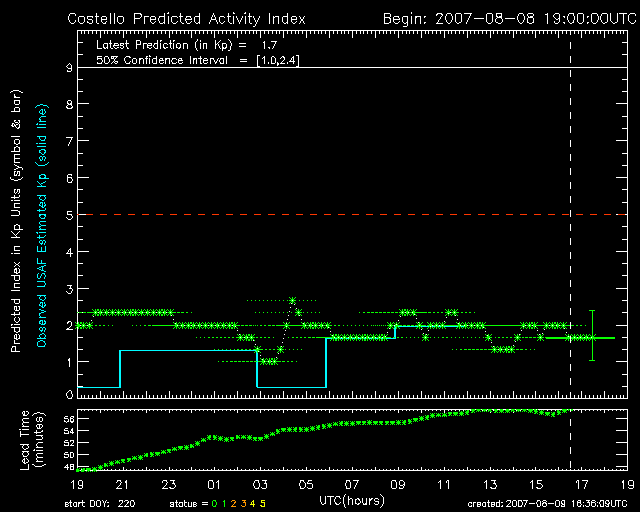
POOLLICHT


Huidige situatie van het poollicht op het noordelijk (links) en het zuidelijke halfrond (rechts).
Klik op de afbeelding voor een uitvergroting (POES Auroral Activity page).


Magnetisch veld en zonnewind (gemiddeld over afgelopen 15 minuten).
Uitleg bij de gegevens


Overige metingen en uitleg:

  • ACE live data 
  • CANOPUS Real Time Auroral Oval 
  • NOAA overview 
  • Auroral Activity Extrapolated 
  •  
  • Kp index 
  • Costello Predicted Activity Index in Kp Units 
  • Relationship between Kp and the Aurora 
  •  
  • Hourly STD DSMP/POLAR Aroral Activity Report 
  • GOES overview 
  •  
  • Tips on Viewing the Aurora 
  •  The Classification of X-ray Solar Flares 
  • NOAA Space Weather Scales 
  •  
  •  Space Radiation Storms 
  •  Coronal Mass Ejections and "Halo Events" 
  •  
  • Nederlandstalig nieuws en foto's:

  • Alles over poollicht 
  • Nader verklaard: Poolicht 
  •  

  • LAATSTE NIEUWS EN WAARSCHUWINGEN


  • Giant sunspot group crackles with flares, setting off auroras

  • September 2005 Aurora Gallery
  • What's Up in Space -- 11 Sep 2005

    AURORA ALERT

    A strong geomagnetic storm is underway, and it is causing some beautiful displays of Northern Lights.

    ACTIVE SUN

    Solar activity is very high. Earth-orbiting satelites have detected seven X-class solar flares in recent days, including an X17-class monster-flare on Sept. 7th. NOAA forecasters say there's a 75% chance of more X-flares during the next 24 hours, possibly causing radio blackouts and radiation storms.

    The source of all this activity is giant sunspot 798:

    The sunspot has grown so large, you can now see it with the unaided eye--but never look directly at the sun!


    A s t r o A l e r t

    11 September 2005

    Solar Terrestrial Dispatch

    MIDDLE LATITUDE AURORAL ACTIVITY WARNING - 11-14 SEPTEMBER

    A middle latitude auroral activity warning has been issued for the next several days. Intense solar flare activity continues. The associated high velocity coronal mass ejections are beginning to become more heavily directed toward the Earth. Several smaller impacts were observed over the last 24 to 48 hours from solar activity that occurred when sunspot complex 10808 was on the eastern limb of the Sun. But now, the region has rotated sufficiently far to produce stronger Earthward-directed impacts.

    The latest impact was observed near 01:19 UTC on 11 September (9:19 pm EDT on 10 September). This disturbance has the potential to produce periods of minor to major auroral storm conditions during the next 12 to 24 hours. Combining this disturbance with several others that are anticipated during the next 48 hours may result in a more volatile mixture of space weather conditions, perhaps capable of producing significant auroral storm activity during the next week. Observers across the United States and Europe (even toward the lower latitudes of the central/southern states) may spot periods of activity during the next week.

    Active sunspot Region 10808 remains exceptionally complex and volatile. It has produced two X-class flares within the last 12 hours (the largest being a class X2.1 event at 22:11 UTC (6:11 pm EDT) on 10 September. Additional strong X-class flares are expected in the coming days. With each passing day, the trajectory of the ejected mass from these events will impact the Earth more directly, resulting in greater opportunities for observers to spot auroral activity.

    The official auroral activity warning statement is appended below. Note the statement indicating there is a good chance the warning may be extended beyond the 14 September deadline.

    MIDDLE LATITUDE AURORAL ACTIVITY WARNING
    Issued: 01:45 UTC on 11 September 2005
    Solar Terrestrial Dispatch
    
    
    VALID BEGINNING AT: EFFECTIVE IMMEDIATELY
    VALID UNTIL: 23:00 UTC (6 pm EST) ON 14 SEPTEMBER
    
    HIGH RISK PERIOD: 11-13 SEPTEMBER (UTC DAYS)
    MODERATE RISK PERIOD: 11-14 SEPTEMBER
    
    PREDICTED ACTIVITY INDICES: 50, 40, 40, 20 (11 - 14 SEPTEMBER)
    
    POTENTIAL MAGNITUDE OF MIDDLE LATITUDE AURORAL ACTIVITY: MODERATE TO HIGH
    
    POTENTIAL DURATION OF THIS ACTIVITY: MAIN BELT = 24-72 HOURS
                                        MINOR BELT = 72-96 HOURS
    
    ESTIMATED OPTIMUM OBSERVING CONDITIONS: NEAR OR AFTER LOCAL MIDNIGHT
    
    EXPECTED LUNAR INTERFERENCE: LOW TO MODERATE
    
    OVERALL OPPORTUNITY FOR OBSERVATIONS FROM MIDDLE LATITUDES: FAIR TO GOOD
    
    AURORAL ACTIVITY *MAY* BE OBSERVED APPROXIMATELY NORTH OF A LINE FROM...
       (THIS LINE IS VALID *ONLY* IF FAVORABLE STORM CONDITIONS OCCUR)
    
       OREGON TO SOUTHERN IDAHO AND NORTHERN UTAH TO WYOMING TO NEBRASKA TO
       NORTHERN MISSOURI TO SOUTHERN ILLINOIS TO KENTUCKY TO VIRGINIA.
    
    ACTIVITY *MAY* ALSO BE OBSERVED APPROXIMATELY NORTH OF A LINE FROM...
       (THIS LINE IS VALID *ONLY* IF FAVORABLE STORM CONDITIONS OCCUR)
    
       CENTRAL FRANCE TO NORTHERN SWITZERLAND TO SOUTHERN GERMANY TO THE CZECH
       REPUBLIC TO POLAND TO CENTRAL RUSSIA.
    
       NEW ZELAND AND SOUTHEASTERN AUSTRALIA SHOULD ALSO BE ABLE TO SPOT PERIODS
       OF ACTIVITY.
    

    SYNOPSIS...

    A series of coronal mass ejections have been directed partially Earthward over the last few days. The Earth is beginning to observe impacts from some of the stronger events. Periods of intensifying auroral activity will be observed during the next several days. The first of the larger impacts occurred near 01:19 UTC on 11 September and is expected to produce periods of minor to major auroral storm conditions, sporadically during the next 12 to 18 hours. Additional strong impacts are expected over the next several days. Some of these disturbances are cannibalizing other CME's, and as a result, the potential geoeffectiveness will likely be complex and difficult to accurately predict. Nevertheless, the potential exists for periods of strong auroral storm conditions developing during the next several days (at least). Near-continuous storm-level activity is possible during the next week, if sunspot complex 10808 continues to impress with energetic flare activity.

    This warning will remain valid through 24:00 UTC (6 pm EDT) on 14 September, with a good chance that it will be extended beyond the 14th. It will be updated or allowed to expire at that time. It will be updated or allowed to expire at that time. For updated information, visit: www.spacew.com/aurora/forum.html. For real-time plots of current activity, visit: www.spacew.com/plots.html

    PLEASE REPORT VALID OBSERVATIONS OF AURORAL ACTIVITY TO: www.spacew.com/submitsighting.html


    Space Weather News for Sept. 10, 2005

    Intense Solar Activity Continues

    Solar activity remains very high and shows no signs of abating. Sunspot 798/808 has unleashed seven X-class solar flares since Sept. 7th. Forecasters say there's a 75% chance of more X-flares during the next 24 hours, possibly causing radio blackouts and radiation storms.

    Coronal mass ejections hurled into space by these explosions could hit Earth's magnetic field in the days ahead. Sky watchers, particularly in northern places like Canada and Alaska, should remain alert for auroras. The best time to look is local midnight.

    The sun's 27-day rotation is slowly turning sunspot 798 to face Earth. Explosions in the coming week will be increasingly Earth-directed, raising the possibility of geomagnetic storms and auroras over the continental United States, Europe and Australia.


    HET POOLLICHT VAN VRIJDAGAVOND 21 JANUARI 2005

    Ole Nielsen maakte op 21 januari rond 20.20 u. deze prachtige opname van het poolicht vanaf de sterrenwacht Rijswijk met zijn Coolpix 4500 camera.
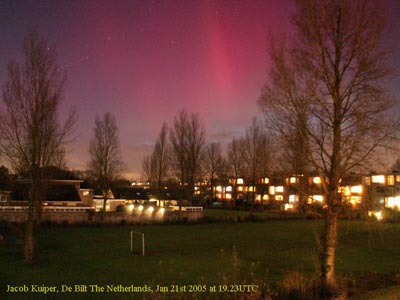
    Meteoroloog Jacob Kuiper zag eveneens een prachtig poollicht en maakte bovenstaande opname vanuit De Bilt.
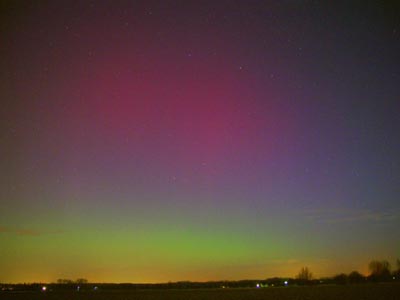
    Henk Bril maakte deze opname om 23.38 u. Er werd 20 seconden belicht op F 2.0 en ISO100 op een Sony DSC-F707.
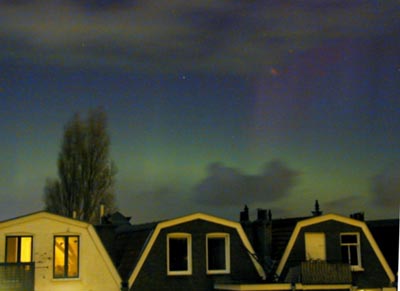
    Job Geheniau fotografeerde om 23:50 u. groen poolicht aan de horizon vanuit Den Haag. Job gebruikte een Olympus 2020Z en belichtte 13 seconden.


  • January 2005 Aurora Gallery
  • What's Up in Space -- 22 January 2005

    EURORAS

    Bright auroras spread across northern Europe on January 21st soon after a coronal mass ejection (CME) crashed into Earth's magnetic field. The impact sparked a severe geomagnetic storm and, by many accounts, the best aurora-display in years.


    What's Up in Space -- 21 January 2005

    IMPACT!

    A coronal mass ejection has just swept past Earth, causing our planet's magnetic field to shake and glow. A severe geomagnetic storm is developing. If it's dark where you live, go outside and look for auroras.

    BIG BANG

    Giant sunspot 720 erupted again on Jan. 20th unleashing a powerful X7-class solar flare. The blast hurled a coronal mass ejection (CME) into space and sparked the strongest radiation storm since October 1989.

    What is a radiation storm? Look at this SOHO coronagraph image of the explosion. Each speckle is a solar proton striking the spacecraft's digital camera. So many protons accelerated to light speed by the explosion and streaming past Earth--that's a "radiation storm."

    Note: ISS astronauts are in no danger from the storm because they orbit Earth inside our planet's protective magnetic field. Plus, the station itself is well shielded.

    Visit Spaceweather.com for more information and updates


    A s t r o A l e r t

    21 January 2005

    Solar Terrestrial Dispatch www.spacew.com

    STRONG X-CLASS SOLAR FLARE, RADIATION STORM AND AURORA WARNING

    A lot has happened in the last 24 to 36 hours. A strong class X7.1 solar x-ray flare was observed on 20 January that resulted in the strongest high-energy space radiation storm since 1989 (last solar cycle). Energetic protons at greater than 100 MeV seldom increase in density above 1 particle flux units (pfu). However, during this major solar flare, energetic protons at greater than 100 MeV increased in density to over 650 pfu. There is evidence that protons at greater than 500 MeV (relativistic energies) bombarded the Earth for several hours after the event. This was the "hardest" proton event since the powerful events of 1989. Energetic proton populations were so intense that neutron densities at ground level over the high latitude regions suddenly increased by more than 50% above background levels, resulting in one of the strongest Ground Level Events of this solar cycle.

    Energetic protons from this flare travelled the distance from the Sun to the Earth at almost the same time that it took light from the Sun to reach the Earth. This is remarkable given the mass of protons and the energy required to accelerate them to very near the speed of light.

    The arrival of these energetic protons at the Earth can result in degradation in the efficiency of solar arrays in orbit to convert sunlight to electricity. As a result, many spacecraft may have observed permanent losses of electrical generation power following this event. The protons also intensely ionized the Earth's high and polar latitude ionospheres, resulting in the complete loss of high frequency radio communications across the high and polar latitudes regions.

    A strong coronal mass ejection was associated with this solar flare, with at least a portion of the ejected mass appearing to have an Earthward-directed component. The impact of this disturbance (which is possible anytime over the next 24 to 36 hours) could result in periods of moderate to strong auroral activity across many dark-sky middle and low latitude regions. A middle latitude auroral activity warning has been issued together with a low-latitude auroral activity watch (see below).

    Region 10720, which has been solely responsible for all of this activity, will be departing the visible side of the Sun and rotating behind the western limb over the next few days. As a result, the influence of this powerful active region will diminish substantially. Whether it survives its transit of the far side of the Sun and reappears two weeks later on the eastern side of the Sun is an unknown question. The region has been undergoing fairly substantial decay over the last few days. Thus, most forecasters believe it will probably diminish in size and complexity as it passes around the far side of the Sun.

    Observers interested in seeing the "northern lights" are strongly encouraged to watch the skies tonight and tomorrow night.

    The low latitude aurora watch is essentially the same as the middle latitude aurora warning (the same boundary lines apply). Thus, only the mid-latitude aurora warning is appended below, with the understanding that a low-latitude watch also exists. Visit www.spacew.com for regular updates and details.

    MIDDLE LATITUDE AURORAL ACTIVITY WARNING
    Upgraded: 20:10 UTC on 21 January 2005
    Solar Terrestrial Dispatch
    www.spacew.com
    
    
    VALID BEGINNING AT: EFFECTIVE IMMEDIATELY
    VALID UNTIL: 23:00 UTC (6 pm EST) ON 23 JANUARY
    
    HIGH RISK PERIOD: 21-22 JANUARY (UTC DAYS)
    MODERATE RISK PERIOD: 21-23 JANUARY
    
    PREDICTED ACTIVITY INDICES: 70, 40, 20, 12 (21 - 24 JANUARY)
    
    POTENTIAL MAGNITUDE OF MIDDLE LATITUDE AURORAL ACTIVITY: MODERATE TO HIGH
    
    POTENTIAL DURATION OF THIS ACTIVITY: MAIN BELT = 12-18 HOURS
                                        MINOR BELT = 18-36 HOURS
    
    ESTIMATED OPTIMUM OBSERVING CONDITIONS: NEAR OR AFTER LOCAL MIDNIGHT
    
    EXPECTED LUNAR INTERFERENCE: MODERATE
    
    OVERALL OPPORTUNITY FOR OBSERVATIONS FROM MIDDLE LATITUDES: GOOD
    
    AURORAL ACTIVITY *MAY* BE OBSERVED APPROXIMATELY NORTH OF A LINE FROM...
       (THIS LINE IS VALID *ONLY* IF FAVORABLE STORM CONDITIONS OCCUR)
    
       EXTREME NORTHERN CALIFORNIA TO NORTHERN NEVADA TO UTAH TO COLORADO TO
       SOUTHERN KANSAS AND NORTHERN OKLAHOMA TO ARKANSAS TO TENNESSEE TO SOUTH
       CAROLINA.
    
    ACTIVITY *MAY* ALSO BE OBSERVED APPROXIMATELY NORTH OF A LINE FROM...
       (THIS LINE IS VALID *ONLY* IF FAVORABLE STORM CONDITIONS OCCUR)
    
       NORTHERN SPAIN AND PORTUGAL TO SOUTHERN FRANCE TO ITALY TO ROMANIA TO
       UKRAIN TO SOUTHERN RUSSIA.
    

    SYNOPSIS...

    The arrival of a fairly strong interplanetary coronal mass ejection (ICME) disturbance has prompted the upgrade of the mid-latitude aurora watch to a mid-latitude aurora warning. Periods of moderate to strong auroral storming could be oberved over the next 12 to 36 hours that should become visible over widespread mid-latitude regions. There is also a slight chance some activity may become visible into the low latitudes. A low latitude aurora watch is being issued as well.

    This warning will remain valid through 23:00 UTC (6 pm EST) on 23 January. It will be updated or allowed to expire at that time. For updated information, visit: www.spacew.com/aurora/forum.html. For real-time plots of current activity, visit: www.spacew.com/plots.html

    PLEASE REPORT VALID OBSERVATIONS OF AURORAL ACTIVITY TO: www.spacew.com/submitsighting.html


    ACHTERGRONDINFORMATIE EN FOTOGRAFISCHE RESULTATEN


    Links naar andere pagina's over poollicht en ruimteweer:

    Nederlandstalig:

    Engelstalig:


    Foto's van het poollicht


    Terug naar ASTRONET's home page